
Agents Need Management, Not Just Prompts
Executive Summary
The strongest signal today is that serious AI-agent discourse is moving from “can the model do the task?” to “how do we govern delegated work once it becomes normal?” The day’s best practitioner items converged on the same answer from different angles: agents need repository comprehension, explicit decision context, observability, and escalation paths—not just better prompts or more permissive autonomy.
That shift matters because it arrives alongside a separate but related business signal: practitioners are increasingly treating OpenAI and Anthropic as having found real product-market fit in enterprise and developer workflows. If usage is becoming durable enough to sustain large model businesses, then agent control surfaces stop being optional polish. They become the operating layer for paid, production AI work.
What Happened
Priscila Andre de Oliveira’s AI Engineer talk, “Comprehend First, Code Later”, offered the cleanest formulation of the new coding-agent posture. Her claim was not that agents eliminate engineering judgment, but that they change where the leverage sits. In her own analysis of 116 Claude sessions, 67% of her usage was comprehension and only 2% was code generation. The practical lesson: in a large, consequential codebase, the highest-value agent work may be building and refreshing the human’s mental model before implementation starts.
That directly complicates the usual “AI writes code now” narrative. Oliveira’s warning—“Don’t ship slop code into the code base that pays your salary”—is less anti-agent than pro-accountability. The human remains responsible for taste, context, and consequences. The agent is most useful when it helps the human understand architecture, conventions, feature history, testing surface, and likely failure modes before a plan hardens.
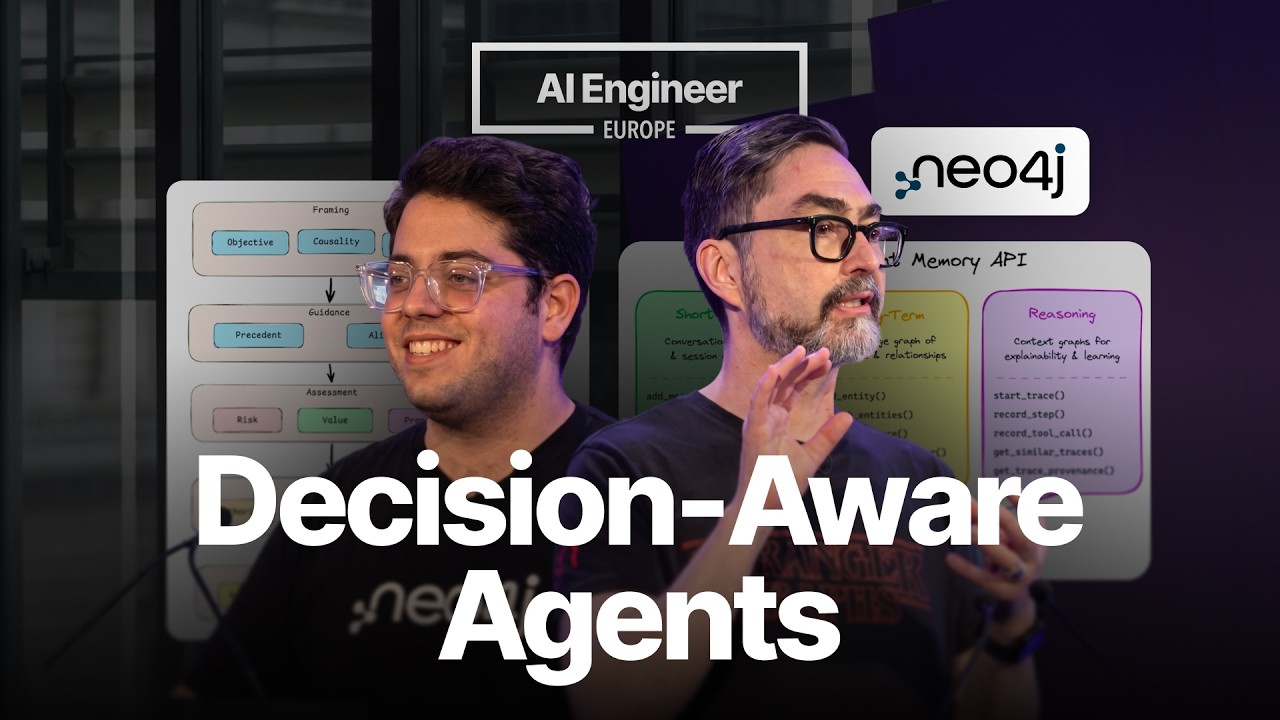
A second AI Engineer talk, “Context Graphs for Explainable, Decision-Aware AI Agents”, pushed the same theme into system architecture. Andreas Kollegger and Zaid Zaim framed context graphs as a way to make implicit organizational knowledge explicit: rules, policies, prior decisions, memory, authority boundaries, and reasons for acting or not acting. Their decision workflow is telling: frame the objective and environment, check precedent and global rules, evaluate risk and value, then act, escalate, or defer depending on certainty and authority.
That is a more mature agent model than “give the model a tool and see what happens.” It treats agency as a governed process, where sometimes the correct output is not an action but a proposal, a set of alternatives, or a request for human judgment.
The Analytics Gap
Nate B Jones’s agent-analytics discussion made the product-management version of the same argument. Using the reported Cursor/Pocket OS database deletion as the motivating failure case, Jones argued that conventional analytics are aimed at the wrong unit. Page views, sessions, chat messages, and AI-feature usage can all look healthy while missing the real behavioral object: the delegated agent run.
His useful distinction is between traces and product analytics. Engineering traces can show tool calls, latency, cost, guardrail hits, errors, and retries. Product analytics needs to connect those events to user intent and outcome: what task was delegated, whether it completed, whether the user accepted the result, how often they corrected or interrupted it, where trust broke, and whether the run advanced a business workflow.
That reframes “agent safety” in product terms. It is not only about preventing catastrophic actions; it is about seeing the shape of delegated work early enough to improve product behavior. Jones’s line that “interruptions and retries and handoffs ... are the new clicks of the agent era” is a strong candidate for the day’s most useful mental model.
The Bigger Story
Simon Willison’s product-market-fit post supplied the business backdrop. He argues that OpenAI and Anthropic appear to have found product-market fit because enterprise API and seat usage is producing meaningful spend, not just experimental interest. The financial specifics remain partly anecdotal and rumor-dependent, so the safe reading is not “Anthropic is definitely profitable.” It is that serious practitioners increasingly see enterprise willingness to pay as real.
Theo’s follow-up video, “Holy sh*t I think Anthropic is profitable now”, echoed that view from a developer angle: coding-agent demand, API-style usage, cloud distribution, pricing tiers, and heavy token consumption all make the enterprise story more plausible than consumer-subscription skepticism suggests. Treat the video as commentary rather than verification, but it usefully captures why developer workflows feel economically different from casual chatbot use.
Workflow Implications
The developing canon is getting sharper: useful agents are not merely generators. They are comprehension aids, delegated workers, decision participants, and product surfaces that need instrumentation. The day’s evidence reinforces a prior digest view that the next layer of AI progress is less about “autonomy” as a slogan and more about operational structure: context, constraints, logs, metrics, escalation, and human ownership.
The practical recommendation is simple: if an organization is adopting agents, it should define the unit of delegated work now. Give each run an identity, record intent and outcome, separate completion from acceptance, capture user corrections, and make rules and precedent available as context rather than buried in human memory. Better models will help, but today’s strongest signal is that better management of agent work may matter just as much.