


Context Platforms Become the Agent Stack
Executive Summary
The clearest signal today was not a new model capability claim, but a shift in how practitioners are naming the infrastructure around agents. The recurring argument: useful AI systems are moving from chat interfaces toward stateful context platforms that ingest organizational knowledge, reason across systems of record, and give agents safe, bounded places to act.
The evidence is still more discourse than proof. Most of the day’s items were short-form commentary, snippets, or vendor-adjacent demos rather than independent case studies. But the overlap is notable: enterprise productivity, personal AI infrastructure, and agentic development all converged on the same missing layer — memory, state, governance, and isolation.
What Happened
Nate B Jones published two short practitioner arguments that framed the future enterprise AI layer as neither search nor chatbot, but a continuously updated context platform. In one short, he argued that “filing cabinets” such as Jira and other enterprise tools become data sources rather than the authoritative place where project knowledge lives. In the follow-up, he sharpened the point: the value in enterprise systems is not storage itself, but synthesis across systems. If SaaS vendors keep the database but lose the synthesis and agentic workflow layer, they risk being pushed down-stack.
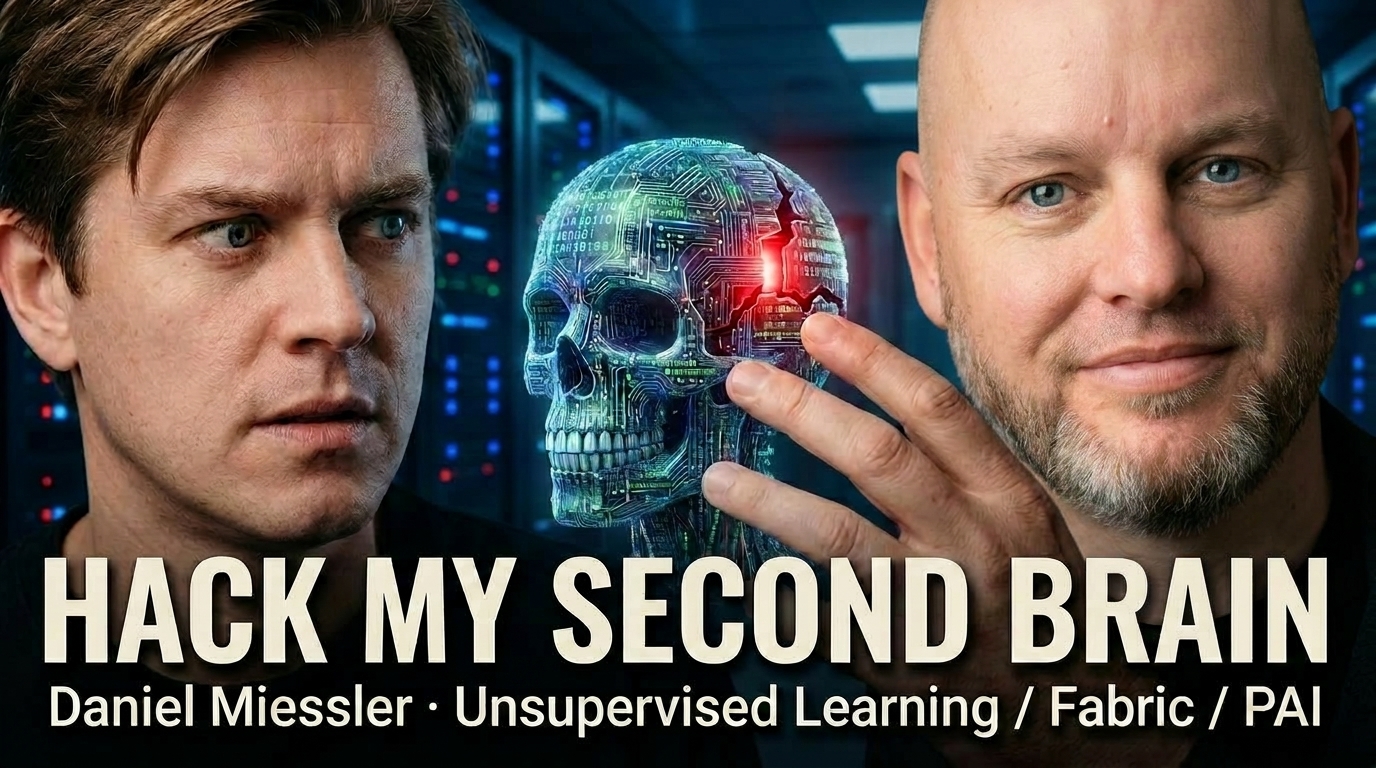
That same frame appeared in a different register in a new Cognitive Revolution episode listing: Daniel Miessler audits Nathan Labenz’s personal AI infrastructure, including a Claude Code memory database and autonomous agents for scheduling, communications, and projects. The available evidence was snippet-level only, so the episode should not be over-weighted. Still, the framing is important: personal AI infrastructure is being treated as something auditable, with memory stores, agent hierarchies, disclosure norms, and security boundaries as explicit design surfaces.
A third supporting example came from Wes Roth’s sponsored walkthrough of Ghost, a Postgres-oriented workflow for giving agents disposable database worlds. The substantive idea is useful even with the sponsorship caveat: code already has branches, diffs, and rollback, but agentic systems also need safe versions of application state. The memorable formulation was that “the database is the state of the world”; letting multiple agents write into the same world is chaos, while giving each agent an isolated fork turns the same behavior into experimentation.
Finally, a Boris Cherny thread pointed to a Salesforce article about “agentic” engineering with Claude Code. The thread reports strong metrics — a migration scoped at 231 days shipping in 13, higher PR volume with incidents down, and security/quality standards embedded into the workflow — but the primary Salesforce page was not independently corroborated in the available evidence. Treat it as a promising supporting lead, not the day’s anchor.
Why It Matters
This reinforces a developing canon in AI workflow discourse: agents are not mainly a better prompt box. They are forcing teams to redesign the substrate around work. The practical questions are becoming less “which model answers best?” and more:
- What system owns durable context?
- Which tools remain systems of record, and which become surfaces or data feeds?
- Where can agents safely write, test, corrupt, revert, and promote changes?
- How are memory, disclosure, hierarchy, permissions, and audit handled?
That is a meaningful shift from the earlier coding-agent narrative. The first wave emphasized speed: autocomplete, code generation, and task acceleration. Today’s evidence points at operating-model change: fewer handoffs, more bounded end-to-end ownership, and infrastructure that lets agents act without turning production state into an experiment.
The Bigger Story
The context-platform thesis is also a threat model for SaaS. If the intelligence layer can sit across Jira, Salesforce, ServiceNow, Postgres, Slack, docs, and email, then existing applications may keep workflows and records while losing the higher-margin synthesis layer. That does not mean SaaS disappears. It means the center of gravity moves from individual apps to whatever maintains the richest, safest, most actionable model of the organization.
The security implication follows directly. The more valuable the context layer becomes, the more dangerous sloppy agent access becomes. “Memory” is not just convenience; it is authority. “Agent hierarchy” is not just architecture; it is delegation. “Branchable databases” are not just developer ergonomics; they are containment.
Workflow Implications
For operators, the takeaway is conservative but actionable: evaluate agent systems by their state model, not just their demo. A useful agent stack should make clear what it knows, where that knowledge came from, what it can mutate, how experiments are isolated, and how successful changes are promoted. If those answers are vague, the system is probably still a chatbot wearing infrastructure language.
Further Reading
- Nate B Jones — “The death of the filing cabinet”: https://www.youtube.com/shorts/59NCmQ3hxz4
- Nate B Jones — “How AI is quietly replacing databases”: https://www.youtube.com/shorts/WPe45FOh7G8
- The Cognitive Revolution — Daniel Miessler audits Nathan’s AI setup: https://www.cognitiverevolution.ai/inside-nathan-s-second-brain-daniel-miessler-security-expert-creator-of-pai-audits-my-ai-setup/
- Wes Roth — Ghost AI disposable database worlds demo: https://www.youtube.com/watch?v=hGCrvDDpl5w
- Salesforce agentic engineering writeup, via Boris Cherny thread: https://www.salesforce.com/news/stories/how-engineering-became-agentic/