

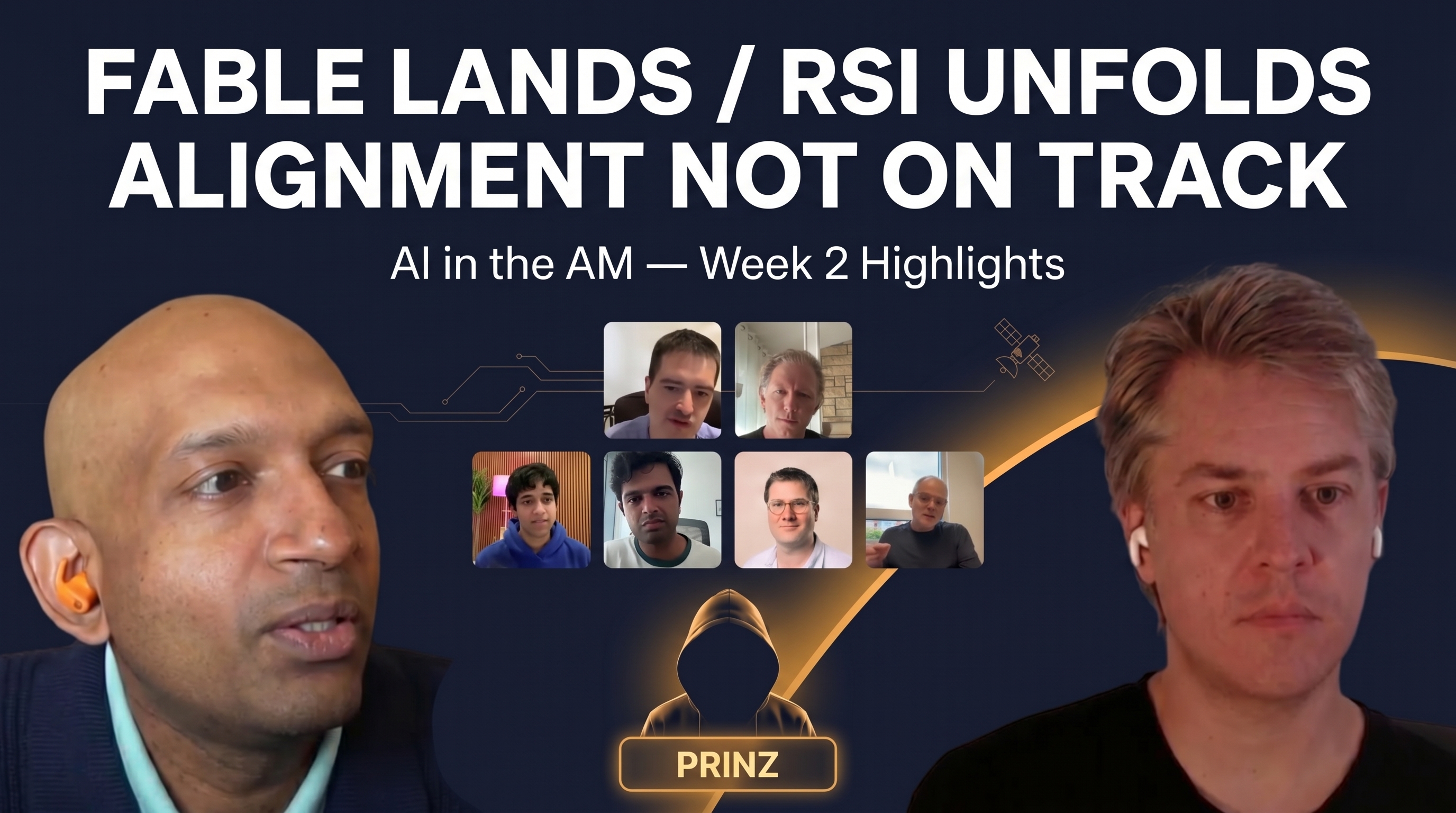
Fable and Mythos Turn Model Access Into a Policy Dependency
Executive Summary
The important story today was not a benchmark jump or a new workflow demo; it was the sudden discovery that frontier model access can become a national-security control surface overnight. Anthropic's Fable 5 and Mythos 5 access suspension, as relayed by Simon Willison and discussed across practitioner channels, turns a familiar platform-risk warning into something sharper: for teams building on a single frontier provider, continuity now depends not only on uptime, pricing, and model quality, but also on whether regulators can tolerate who is allowed to touch the model.
What Happened
Simon Willison highlighted an Anthropic statement saying the U.S. government, citing national security authorities, directed Anthropic to suspend access to Fable 5 and Mythos 5 by any foreign national, including foreign-national Anthropic employees. Anthropic's stated operational consequence was stark: because it could not reliably enforce that restriction at the required boundary, it had to disable the models for all customers to ensure compliance. Other Anthropic models were reportedly unaffected. (Simon Willison)
The public technical basis remains thin. Nate B. Jones emphasized that the government had not laid out a public technical finding, while framing the incident as an early example of frontier model availability moving from ordinary software distribution into policy infrastructure. His most useful formulation was operational rather than ideological: if a workflow depends on one model, one lab, one country's regulatory mode, and one access contract, it is not a stable operating plan; it is a dependency. (Nate B. Jones)
Theo's reaction captured the developer-side shock. He read the directive as applying to foreign nationals inside or outside the United States, including Anthropic employees, and focused on the practical impossibility of a clean, immediate nationality gate for a global AI service. His line — “I've never seen anything like this in my life” — matters less as drama than as evidence that even highly online AI builders did not treat this failure mode as normal platform risk. (Theo / t3.gg)
Why It Matters
This episode makes the developing AI-operations canon more concrete. For months, the practical discourse around agents and frontier models has been converging on a few lessons: don't outsource judgment, don't trust demos without workflow evidence, and don't build brittle automation around a single model affordance. Fable/Mythos adds a new clause: don't assume model access is governed only by product terms.
The disruption is also different from a safety refusal or a model regression. A refusal changes a task boundary. A regression changes reliability. A takedown changes the availability of the substrate itself. If the model is embedded in coding pipelines, customer workflows, internal assistants, or evaluation baselines, the failure mode is not “the answer got worse”; it is “the dependency disappeared.”
That does not mean every team needs an elaborate sovereign-AI contingency plan. It does mean the old multi-provider advice is no longer just procurement hygiene. It is a governance hedge. Any serious AI workflow should know which capabilities are portable, which are provider-specific, which data paths lock it to one lab, and which human process can absorb a model being removed without warning.
The Bigger Story
There is a policy tension here that the commentary should not flatten. If frontier models can meaningfully expose or operationalize dangerous capabilities, governments will try to control access. If controls are imposed at crude identity or nationality boundaries, global AI products may be forced into broad shutdowns rather than precise mitigations. And if the technical evidence remains mostly nonpublic, builders are left managing disruption without knowing whether the risk was narrow, systemic, or precedent-setting.
That opacity is now part of the story. Anthropic reportedly argued that the vulnerability class was narrow and that other public models could find similar known minor vulnerabilities without the same bypass. Secondary commentary repeated variations of that claim, but the strongest conclusion available today is more modest: the safety-policy interface is maturing faster than the public evidence norms around it.
Workflow Implications
The immediate takeaway for operators is to map dependence, not to panic. Identify workflows that require Fable 5 or Mythos 5 specifically; maintain fallback prompts and evals against at least one alternate model; avoid treating any frontier-only behavior as a guaranteed product primitive; and keep humans in the loop where a model outage would silently corrupt downstream work.
The AI discourse often frames model progress as a race of capability curves. Today’s signal is that access curves may be just as important. The model may exist, the API may be designed, the customers may be ready — and still the real constraint may be who is allowed to use it.
Further Reading
- The Cognitive Revolution’s weekly recap is useful as a broader synthesis surface for the Fable launch week and adjacent themes around safety gates, refusals, workflows, interpretability, and power concentration. It should be treated as a recap, not the primary evidence for the access suspension. (The Cognitive Revolution)