
Synthetic Media Needs a Trust Stack
Executive Summary
The clearest signal from the day was not a new model capability, but a norm-setting problem: synthetic media is now good enough that low-attention audiences can be fooled, while the old binary question — “AI or not AI?” — is too blunt to support trust. The useful frame is shifting toward disclosure, provenance, control, judgment, and accountability: where did AI enter the production chain, who approved the output, and who remains responsible for the claims?
What Happened
Nate B Jones published a practical creator-facing video, “You Can't Tell If I'm Real Anymore. And That's Now YouTube's Problem Too.”, arguing that voice cloning has crossed an important social threshold. It does not need to be perfect. It only needs to be “good enough” in contexts where people are half-listening: a podcast clip, a background YouTube video, an ad, a repost, or a short that arrives without much context.
His distinction is useful because it avoids the familiar trap of asking whether synthetic content is totally indistinguishable from human content. Full human presence is still hard: faces, lips, hands, blinking, pacing, timing, and micro-expressions still expose many generated or manipulated videos. But voice is different. When clean source audio exists, the barrier to plausible impersonation is much lower, and the audience often lacks the attention, tools, or context to detect the substitution.
That makes platform and creator norms more important than raw detection. Jones proposes a “creator trust stack”: disclosure, provenance, control, judgment, and accountability. In plain terms: say when synthetic media is used; preserve evidence of origin; do not clone voices or likenesses without consent; keep a human responsible for editorial choices; and establish policy before a likeness incident forces the issue.
Why It Matters
This reinforces a recurring digest view: AI discourse is maturing from capability spectacle into accountability design. The next problem is less “can this be generated?” and more “what social contract makes generated work legible?”
That matters because disclosure alone is insufficient. A vague label saying “AI was used” does not tell an audience whether AI cleaned background noise, drafted a script, generated a synthetic voice, altered a person’s likeness, or fabricated an entire scene. Those are different trust events. They demand different levels of consent and scrutiny.
The more durable norm is therefore chain-of-responsibility disclosure. Viewers do not need every implementation detail, but they do need to know where human judgment entered. A synthetic voiceover approved by the real creator is not the same as an unauthorized clone. A model-assisted edit is not the same as a generated claim. A clearly labeled reconstruction is not the same as an implied recording.
The Bigger Story
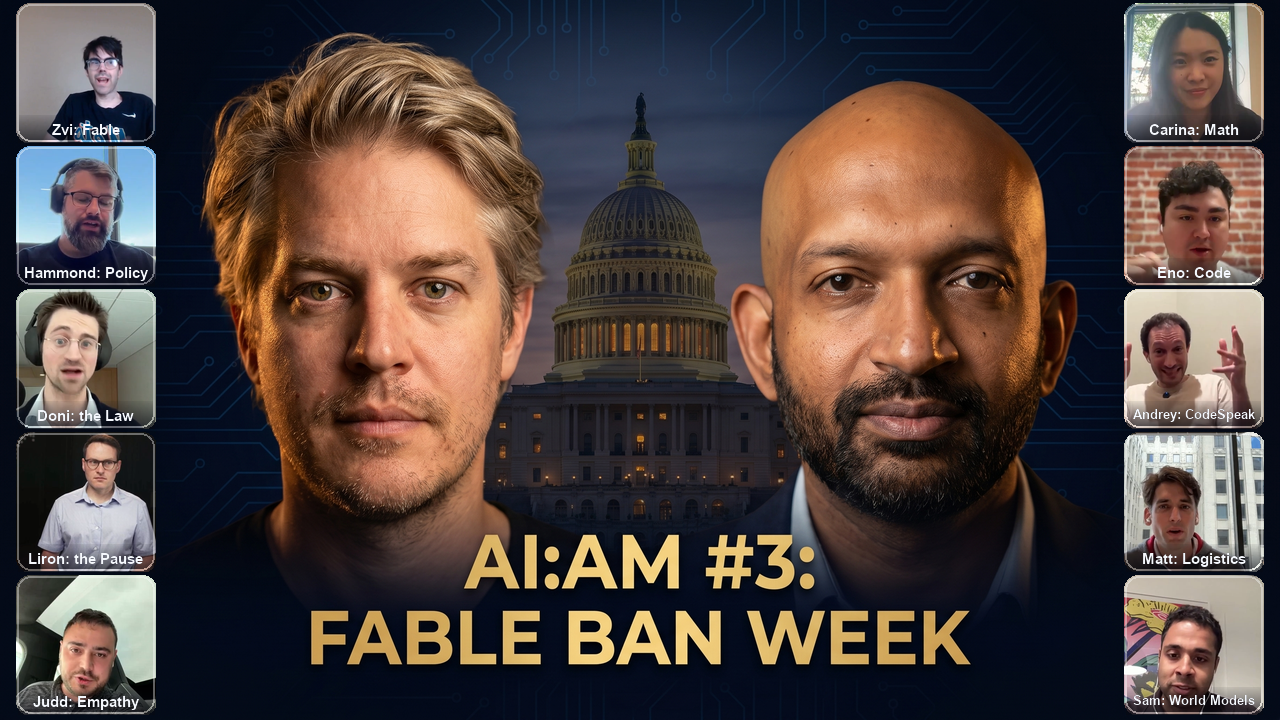
A second, softer signal points at the same broader discourse shift. In a delayed-discovery item, The Cognitive Revolution posted “AI:AM #3: Zvi on Fable, the Cases For & Against the Ban, + AI for Math, Logistics & More”. The available evidence is summary-level rather than transcript-verified, so it should not be treated as a source for detailed claims. Still, the episode framing is notable: Anthropic’s Fable system card, math gains, deceptive behavior, decision theory, interpretability, export controls, medicine, logistics, and software all appear in one conversation.
That clustering is the point. The live debate around AI is no longer cleanly separable into “model progress,” “safety,” “policy,” and “product.” A single system can be discussed as a math advance, a governance risk, a deployment question, a strategic asset, and an interpretability problem. The creator-media trust issue is part of that same convergence: once AI systems touch public artifacts, the question becomes institutional design, not just model quality.
Workflow Implications
For teams using or shipping AI-generated media, the practical takeaway is simple: write the policy before the incident. Decide which uses require consent, which uses require visible disclosure, which uses require provenance records, and who signs off on final claims. “AI-assisted” should not be a single bucket.
For readers and operators, the useful habit is to ask a sharper question than “was this AI?” Ask: what was synthesized, from whose data or likeness, under whose control, and who is accountable if it misleads? That question will age better than most detection heuristics.
Further Reading
- Nate B Jones — “You Can't Tell If I'm Real Anymore. And That's Now YouTube's Problem Too.” — the strongest item of the day; useful for creator and platform trust norms.
- The Cognitive Revolution — “AI:AM #3: Zvi on Fable…” — delayed-discovery supporting item; worth revisiting once full transcript-level evidence is available.