



Executive Summary
The strongest AI discourse today was a step away from model mystique and toward systems craft: builders are increasingly treating agent performance as a harness-design problem before they treat it as a model-selection problem. The clearest evidence came from a detailed AI Tinkerers / Post-Training writeup arguing that structure, constraints, and decomposition produced a larger gain than retrieval tweaks alone, with other signals reinforcing the same theme from local deployment, security, and longer-term research directions.
What Happened
The anchor item was Hitesh Jain’s AI Tinkerers / Post-Training essay on building a winning agent harness. Its core claim is blunt: a struggling finance-research agent was limited less by the base model than by the way the system around the model had been assembled. Too many overlapping instructions, too many tools, and too much prompt mass created failure on harder tasks. Jain’s proposed fix, Reef, centers on a skills-first harness with specialist agents, runtime constraints, lazy-loaded guidance, and typed interfaces instead of ever-growing prompt text.
What makes the piece matter is not just the architecture sketch but the claimed result. Jain reports that retrieval improvements alone moved a finance-agent benchmark from 44.87% to 49.8%, while the full harness redesign reached 82.6%. Those are author-reported numbers, not independent validation, but they are still a strong discourse signal because they put a measurable stake in the ground: agent quality may now hinge more on orchestration than on squeezing another few points from the underlying model.
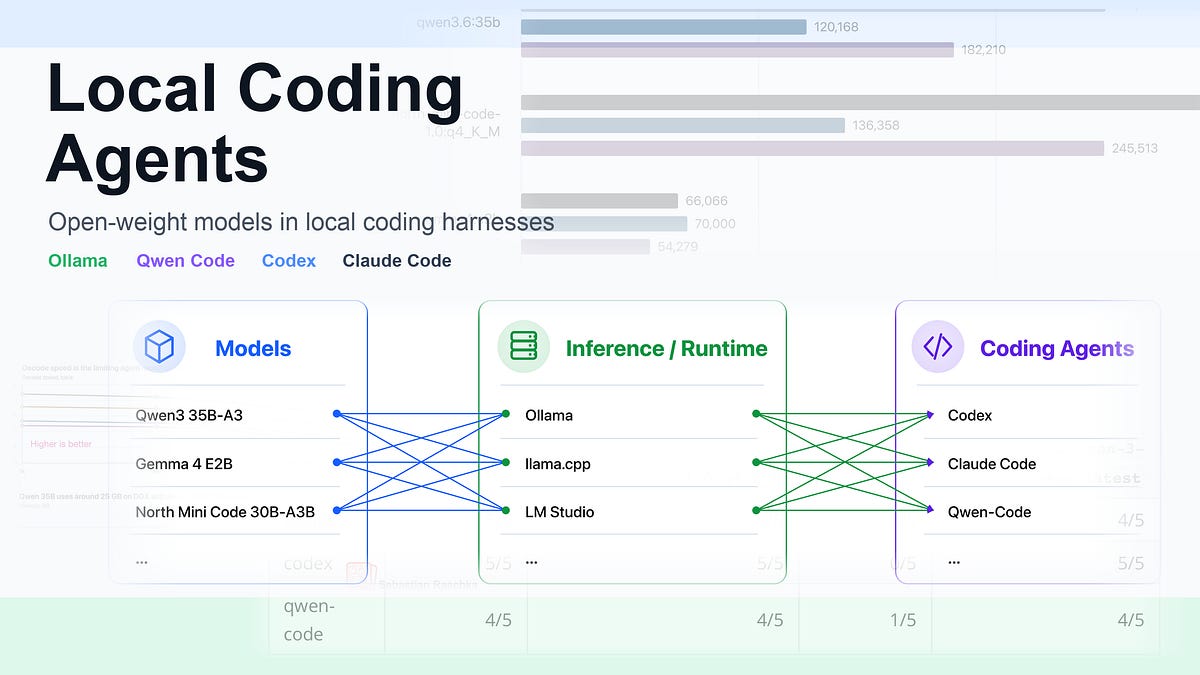
Sebastian Raschka’s guide to using local coding agents pushed the same conversation in a more operational direction. His framing is not that local models suddenly beat frontier hosted systems; it is that for some workflows they have become usable enough that privacy, reproducibility, offline use, and predictable cost enter the decision. Just as important, Raschka spends serious time on shell access, telemetry, secret handling, and sandboxing. That emphasis fits the day’s broader pattern: once agents are real tools instead of demos, the decisive questions become integration, boundaries, and operating discipline.
Why It Matters
This is a meaningful shift in the canon of agent discourse. Earlier waves of conversation leaned heavily on prompts, tool calling, and raw benchmark or leaderboard excitement. Today’s stronger evidence says the performance frontier is moving up a layer. The hard part is increasingly how work is routed, what context is loaded when, which tools are exposed, what constraints are enforced, and how failures are contained.
That also helps explain why security discussion is getting more empirical. Simon Willison’s note on the hack-my-ai-assistant prompt-injection challenge was a delayed-discovery item from late yesterday’s window, but it fits today’s theme cleanly. The interesting signal is not “prompt injection is solved.” It is that an email-driven agent with explicit guardrails reportedly withstood thousands of attacks well enough to shift the conversation toward concrete defensive design rather than abstract inevitability. In other words, harness quality is starting to matter for safety discourse too.
The Bigger Story
The late-arriving Dwarkesh essay, The next paradigm, broadened the frame beyond day-to-day engineering. As a delayed-discovery item, it argued that current reinforcement-learning progress works best in domains that are not just verifiable but highly replayable and parallelizable. That is a useful complication to the current optimism around agents. If the present recipe depends on “grindable” tasks, then better harnesses may unlock a lot of near-term value without fully solving the deeper problem of agents that learn on the job in messy, sparse-feedback environments.
That tension makes today’s evidence more interesting, not less. The practical builder story says agent systems still have substantial headroom from better scaffolding, narrower skills, stronger constraints, and saner tool surfaces. The research-level story says those gains may still run into a ceiling unless deployment experience can somehow make its way back into training. Put differently: the industry may still have plenty of easy wins in system design even if the longer-term paradigm question remains open.
Workflow Implications
For practitioners, the takeaway is concrete. If an agent is underperforming, inspect the harness before blaming the model. Reduce instruction overlap. Narrow tool access. Make retrieval and verification explicit. Split broad agents into specialized roles when tasks genuinely decompose. Treat typed interfaces and runtime constraints as first-class product features, not cleanup work.
Teams experimenting with local agents should add a second checklist: where do secrets live, what telemetry leaves the machine, when can shell actions run, and what must stay sandboxed? The lesson from today’s discourse is that agent quality and agent safety are increasingly the same design conversation.
Further Reading
- Hitesh Jain, How to write a winning agent harness for your domain
- Sebastian Raschka, Using local coding agents
- Dwarkesh Patel, The next paradigm
- Simon Willison, Hack my AI assistant