






Executive Summary
The center of gravity in AI discourse keeps moving away from prompt cleverness and toward infrastructure: the reusable skills, harness rules, and trust boundaries that decide whether an agent is dependable in real work. Today’s strongest evidence came from a detailed builder writeup showing large benchmark gains from harness design rather than model swapping, with a second supporting signal that product teams now treat skills as shared operating assets. A delayed-discovery security story sharpened the same point from the opposite direction: once agents sit close to code, shell, and internal workflows, even small hidden telemetry choices become a trust problem.
What Happened
The clearest item was Hitesh Jain’s Post-Training essay on Reef, a skills-first agent harness built for finance work (AI Tinkerers / Post-Training). The striking claim was not a new model breakthrough but a systems result: on Vals AI Finance Agent v2, Jain reports 44.87% pass rate for the reference harness, 49.8% for improved retrieval alone, and 82.6% for the full Reef / AlphaCumen setup using the same underlying model family and data regime. The argument is that the biggest lift came from structure encoded in the harness: lazy-loaded skills, typed Python bindings, planner-versus-specialist separation, and runtime constraints that force retrieval before answers and enforce date boundaries in code instead of prompt prose.
That matters because it fits a pattern that has been getting harder to ignore. The failure mode Jain describes is familiar across agent work: prompts and tool lists grow until they become their own source of confusion. His prescription is to move conventions out of giant instructions and into explicit interfaces, narrow skill scopes, and runtime guardrails.
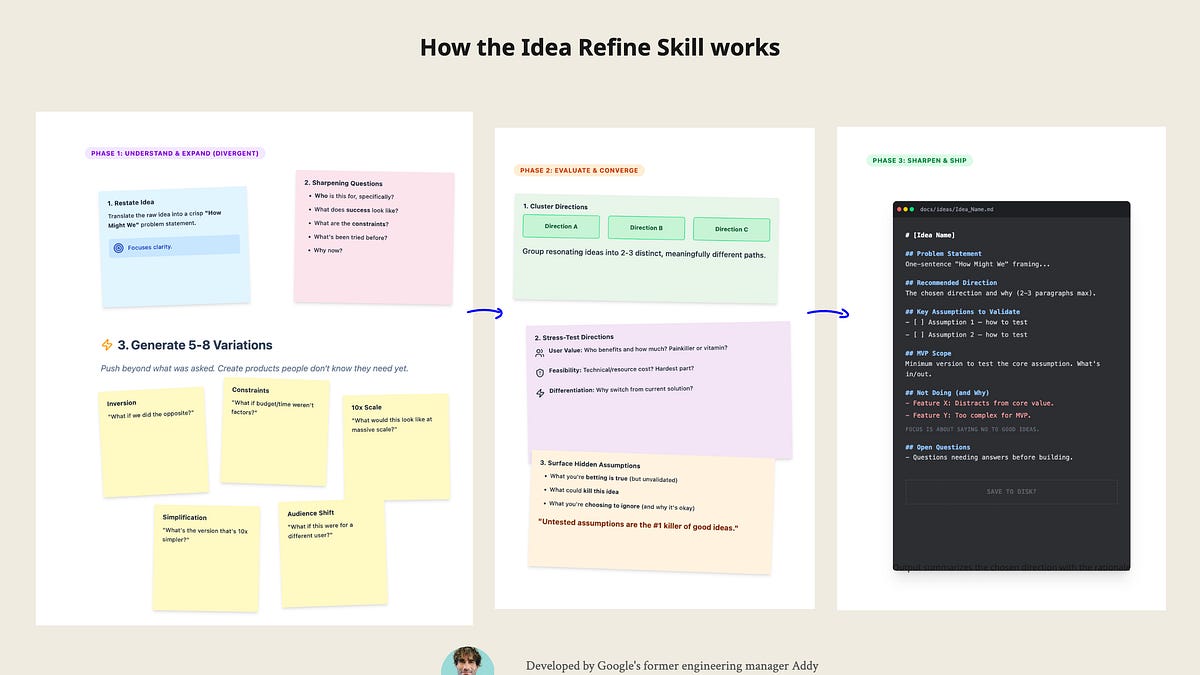
Rich Holmes’ new product-focused piece reinforced that this logic is escaping engineering-only circles (Department of Product). Even through the paywall-limited view, the frame is clear: agent skills are becoming normal product-work infrastructure, not niche prompt artifacts. Holmes points to companies using reusable skills for reporting, testing, and internal libraries, then organizes the rest of the piece around concrete, repeatable product tasks rather than one-off chatbot tricks. That is a small but meaningful discourse shift. “Skills” are starting to look less like hacks and more like the unit of organizational memory for AI-assisted work.
The strongest counterpoint was a delayed-discovery security story. Thereallo’s reverse-engineering writeup found that Claude Code had been marking some requests with subtle prompt variations tied to API base URL and timezone (Thereallo). Ars Technica then reported that Anthropic described the behavior as a March experiment aimed at abuse prevention and distillation defense and said it was removed after disclosure (Ars Technica). This was not the biggest item of the day in pure capability terms, but it mattered because it exposed how thin the tolerance is for hidden behavior once a coding agent has meaningful local access.
Why It Matters
Taken together, these items point to a maturing canon for agents. The practical frontier is increasingly not “which model should I pick?” but “what system surrounds the model, what can it load, what must it check, and what is visible to the operator?”
The Reef post strengthens the case that harness quality can dominate prompt quality. The Holmes piece suggests that reusable skills are turning into cross-functional assets, which means agent design is becoming an organizational problem as much as a model problem. And the Claude Code episode shows that once agents become workflow infrastructure, governance details stop being side issues. Telemetry, disclosure, default trust assumptions, and access boundaries all become product questions.
That complicates but does not weaken the agent story. It makes it more concrete. Progress is still happening, but the durable gains appear to come from better scaffolding, narrower abstractions, and more explicit operating rules. At the same time, deeper adoption raises the bar for transparency. The same industry that is learning to encode more behavior into harnesses will also be judged more harshly for anything it encodes invisibly.
Workflow Implications
For builders, the immediate lesson is to treat harness design as first-order product work. If reliability improves only when you add more instructions, you may be masking the real problem.
Encode domain conventions in code where possible, not in sprawling prompt text. Keep skills small enough to be inspectable and reusable. Separate planning from specialized execution when tasks naturally branch. Add hard runtime checks for things the model should not get to improvise, especially retrieval-first rules and time-bounded data access.
Just as important, make trust boundaries explicit. If a tool with repository, shell, or browser access needs telemetry or policy enforcement, surface that behavior plainly. The more capable the agent, the less tolerance users will have for hidden signaling or ambiguous defaults.
Further Reading
- Hitesh Jain’s full Reef writeup is worth reading for the concrete implementation details and benchmark framing, even if you treat the performance claims as domain-specific until independently reproduced: https://post-training.aitinkerers.org/p/how-to-write-a-winning-agent-harness-for-your-domain
- The Claude Code tracking story is useful not just as controversy, but as a case study in how fast agent-tool trust can erode when disclosure lags behavior: https://thereallo.dev/blog/claude-code-prompt-steganography