

Executive Summary
The most important shift in today’s AI discourse is that frontier-model launches are no longer being framed as one smarter chatbot. OpenAI’s GPT-5.6 release and its accompanying product changes present a more segmented idea of AI work: quick chat for conversation, a distinct Work mode for longer research and deliverables, and Codex for software development. That matters because it suggests the center of competition is moving from raw model quality alone to how well vendors package models into task-specific working environments.
What Happened
OpenAI’s GPT-5.6 launch was the clearest concrete signal. The company did not just announce a stronger flagship model and cheaper smaller variants. It also made efficiency-per-dollar a headline part of the pitch, introduced Programmatic Tool Calling as a way to reduce tool-loop overhead, and highlighted an ultra setting that coordinates multiple agents in parallel for harder work. In other words, the release was framed as a system for getting work done, not simply as a benchmark update.
Source: https://openai.com/index/gpt-5-6/
The companion Help Center documentation made the interface split explicit. OpenAI now describes Chat, Work, and Codex as separate experiences: Chat for conversational help, Work for research and finished materials, and Codex for code, repositories, tests, and developer tools. It also draws an operational boundary between cloud and desktop use. Work on web and mobile runs in the cloud, while desktop Work can use local files and apps with permission; at launch, those desktop threads and local files remain local rather than flowing automatically into cloud Work.
Source: https://help.openai.com/en/articles/20001275-chatgpt-work-and-codex
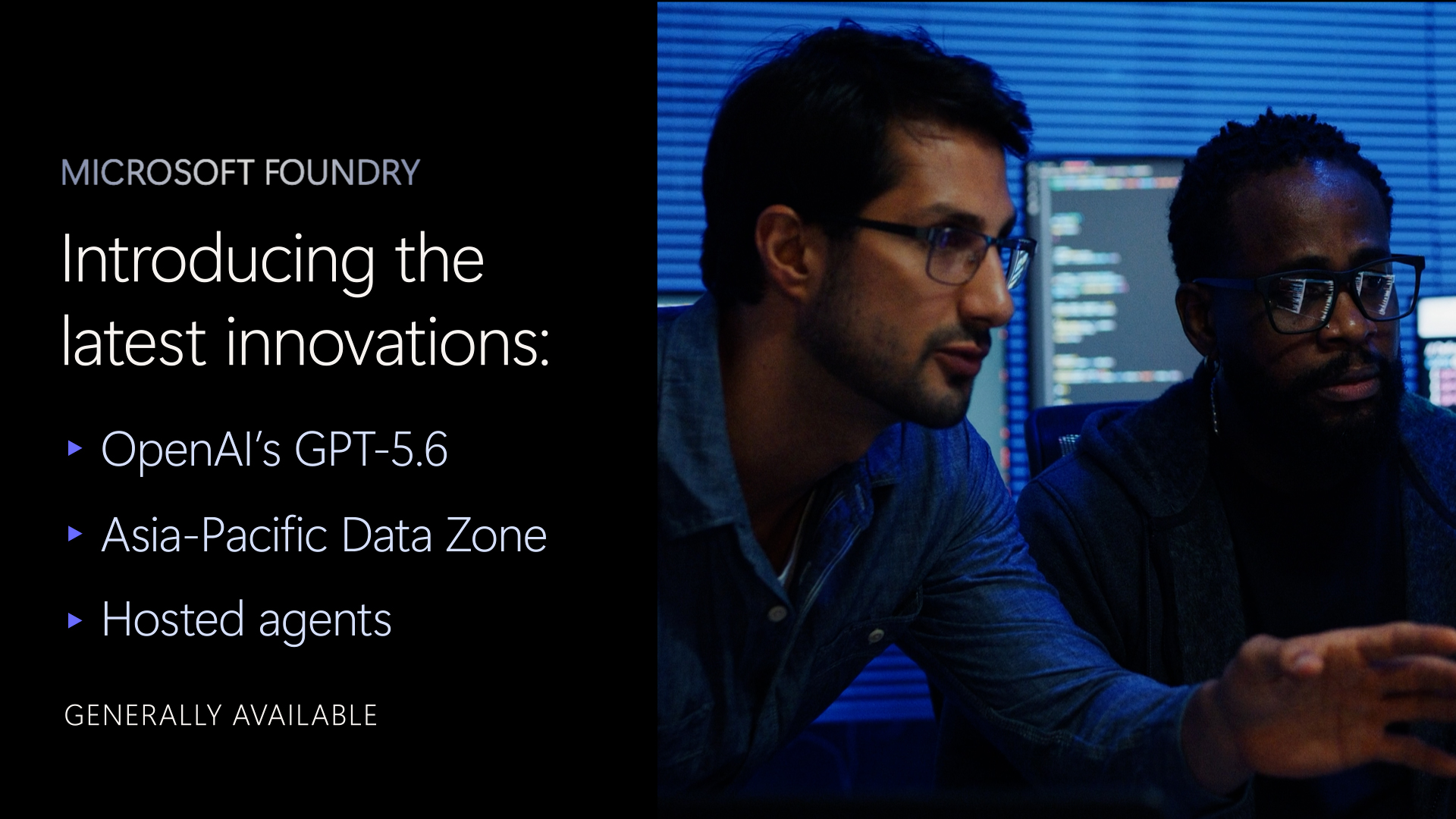
Microsoft’s same-day Foundry announcement reinforced that this is not just OpenAI interface reshuffling. Microsoft bundled GPT-5.6 model access with hosted agents, toolboxes, tracing, evaluation, memory, routines, network isolation, and publishing into Microsoft 365 Copilot and Teams. The sales story was not “here is a better model.” It was “here is a production stack for agents, with governance and distribution built in.”
The strongest practitioner commentary in the ledger sharpened the workflow side of the same pattern. Nate B Jones argued that the present bottleneck for agents is not model access but task routing: people still do not reliably know when work should stay in chat, when it should go to one agent, when it merits multiple agents, and when it still requires human judgment. His proposed tests were practical rather than futuristic: Is the task big enough, are the parts independent, do you need separation of concerns, and can the result be checked cheaply?
Source: https://www.youtube.com/watch?v=PRqiGS6fnIM
Why It Matters
This strengthens a developing canon in AI discourse: agent progress is becoming less about whether a model can use tools at all and more about whether a system can assign the right mode of work, decompose it, verify it, and deliver the result inside the surface where people already operate.
That is why the OpenAI documentation matters more than it might look at first glance. A separate Work mode is effectively an admission that “chat” is no longer the universal wrapper for all serious AI use. The product is being reorganized around job shape. Coding, long-form research, and quick interaction are being treated as different operating modes with different permissions, runtimes, and expectations.
Microsoft’s framing pushes the same logic into enterprise infrastructure. Once vendors start selling models together with hosted runtimes, memory, observability, publishing paths, and compliance controls, the argument shifts from “Which model is best?” to “Which environment makes agents dependable enough to deploy?” That is a bigger commercial and practical shift than another narrow benchmark win.
The Bigger Story
Today’s evidence also complicates the louder autonomous-agent narrative. The interesting move is not toward one general super-agent doing everything. It is toward a managed portfolio of modes, agents, and checkpoints. The more powerful the models get, the more valuable routing and governance appear to become.
That fits the practitioner mood in the ledger. Builders are talking less about spectacle demos and more about selection discipline: what work is checkable, what can be safely split up, and what still depends on human judgment. The discourse around agents is maturing from capability theater into managerial design.
Workflow Implications
For hands-on teams, the practical lesson is to design an explicit routing policy before expanding agent usage. Decide which tasks stay as chat, which deserve a dedicated work surface, which justify multi-agent decomposition, and which remain human-owned because the evaluation loop is too subjective. If you cannot explain how a task will be checked, you probably should not escalate it into a more expensive agent workflow.
One useful near-term experiment is to take a recurring document-heavy or review-heavy task and run it through four buckets: chat, single-agent, multi-agent, or human-only. Measure not just speed, but review burden and error detectability. That will tell you more about real agent readiness than another model ranking chart.
Further Reading
- OpenAI’s GPT-5.6 launch page: https://openai.com/index/gpt-5-6/
- OpenAI’s product documentation for ChatGPT Work and Codex: https://help.openai.com/en/articles/20001275-chatgpt-work-and-codex
- Microsoft’s Foundry announcement for production agents: https://azure.microsoft.com/en-us/blog/frontier-models-and-production-agents-advancing-microsoft-foundry-for-the-agentic-era/