


.png)
Coding Agents Hit the Verification Wall
Executive Summary
The most important shift in today’s AI discourse was not a fresh model demo but a clearer admission from practitioners that coding agents are now constrained by verification, not generation. As code output gets cheaper and more abundant, the scarce capability is proving correctness, security, maintainability, and fit inside large real codebases.
What Happened
The strongest item in the ledger was a new AI Engineer talk from Sonar CEO Tariq Shaukat, which made the current bottleneck unusually explicit. His argument was that the industry has spent plenty of time measuring whether models can generate plausible code, but much less time confronting the harder question: can teams trust that code enough to ship it inside complex, long-lived systems?
That distinction matters because the gap between “it worked in a benchmark” and “it is good enough for production” appears to widen as standards rise. In Shaukat’s framing, long-horizon coding tasks can look impressively solved at low success thresholds while enterprise-grade usefulness falls off sharply once the bar includes security, maintainability, reliability, and architectural fit. His proposed answer is not to wait for another model jump. It is to build an agent-centric development loop around explicit guidance, layered verification, and repeated checking rather than treating review as a cleanup step at the end.
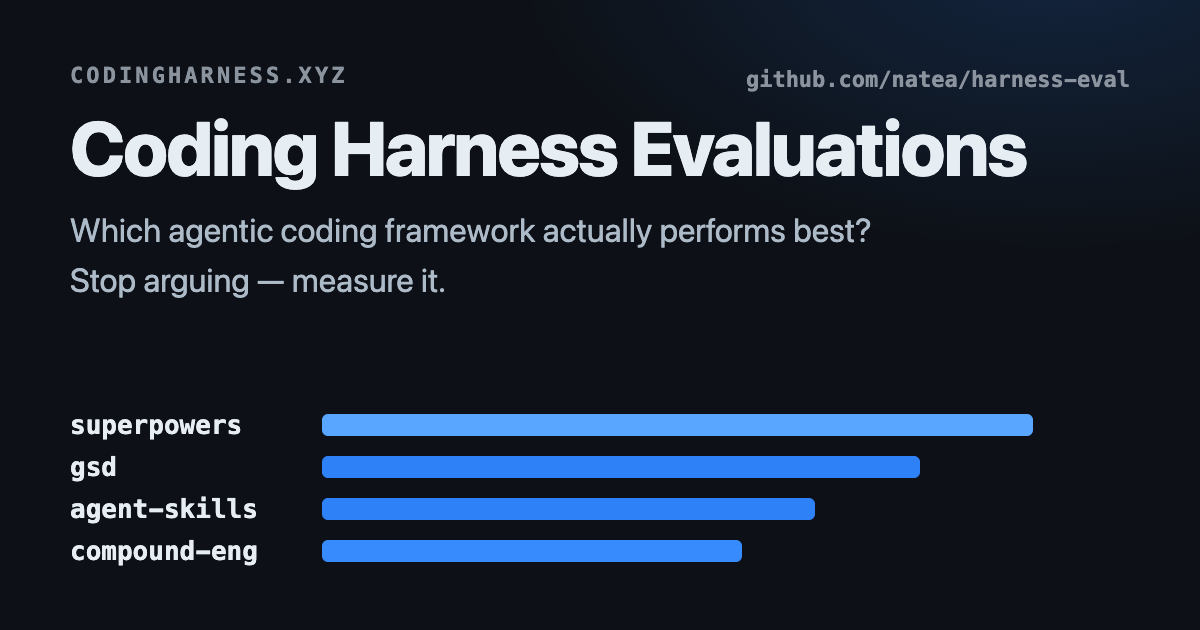
The best supporting evidence came from CodingHarness.xyz, a project built around a simple but increasingly important question: if you hold the model, the specification, and the sandbox constant, how much value is the agent framework itself actually adding? Its setup compares frameworks on the same coding task, then grades them with a mix of product-spec adherence on a running artifact, blind code-quality judging, and telemetry on speed and token spend. Just as important, it explicitly asks whether orchestration helps more than a bare-model baseline at all.
Together, those two items make the day’s core point sharper than usual. The discourse is moving away from “which coding agent feels smartest?” and toward “which system can be verified, compared fairly, and shown to create net value after review costs are counted?”
Why It Matters
This reinforces a canon that has been building for months in builder circles: the model is no longer the whole product, and raw generation is no longer the whole test.
Earlier discourse often treated coding-agent progress as mostly a model-capability story. Then the emphasis shifted toward harness design, tool structure, and workflow scaffolding. Today’s evidence pushes that one step further. The harder problem now looks like control: what evidence accompanies the output, what checks gate it, what failure modes are caught automatically, and how much hidden complexity the team is accepting in exchange for speed.
That is a more mature framing of AI productivity claims. A reported 3-5x gain at the start of adoption is much less persuasive if the savings are later consumed by bugs, security issues, brittle abstractions, and maintenance debt. Verification is becoming the place where inflated AI ROI stories go to be tested.
CodingHarness matters here because it adds a methodological correction. If teams only compare one framework’s best demo against another framework’s marketing, they learn almost nothing. If they compare frameworks under the same task and judge whether the extra orchestration beats a simpler baseline, they can finally see where the complexity is paying for itself.
The Bigger Story
There was also a delayed-discovery item that raised the stakes beyond developer workflow. A UK AI Security Institute post published on July 17 argued that leading open-weight models in cyber now trail frontier closed models by roughly 4 to 7 months, narrower than the 6 to 10 month gap it had measured through most of 2025.
That matters because it connects today’s verification story to the broader diffusion story. If powerful capabilities are becoming more widely deployable, then verification is not just an enterprise software hygiene issue. It becomes part of security posture, governance, and deployment discipline. The same ecosystem that is learning not to trust plausible code without checks is also learning that open access and lower guardrail density can compress the time available to adapt.
So the developing canon is getting clearer: stronger models still matter, but their practical impact is increasingly determined by the systems around them — evals, harnesses, review loops, and safeguards. Today’s discourse did not weaken that view. It made it harder to ignore.
Workflow Implications
For hands-on builders, three practical checks follow from today’s evidence:
- Measure acceptance, not just generation. Track the share of AI-produced work that survives review and actually ships, not just the share that looks promising on first pass.
- Compare orchestration against a bare baseline. If a framework adds planners, loops, or tool layers, test whether those layers improve quality enough to justify their cost and complexity.
- Build verification into the loop early. Treat security, maintainability, and spec adherence as first-class checks during execution, not as a human-only audit after the agent is “done.”
The broader takeaway is simple: coding agents are no longer being judged mainly by whether they can produce code. They are being judged by whether they can produce work that remains valuable after serious verification. That is a much higher bar, but it is also a healthier one.
Further Reading
- AI Engineer: Tariq Shaukat on verification-heavy coding-agent workflows and the enterprise gap between plausible output and shippable software. https://www.youtube.com/watch?v=VrpEyglYgeU
- CodingHarness.xyz: a controlled framework-comparison project that tests whether agent scaffolding actually beats simpler coding baselines. https://codingharness.xyz
- UK AI Security Institute: “How far behind the frontier are leading open-weight models on cyber?” — a concrete measurement of the narrowing open-versus-closed gap in a sensitive domain. https://www.aisi.gov.uk/blog/how-far-behind-the-frontier-are-leading-open-weight-models-on-cyber