

Astra Makes the Harness the Story
Executive Summary
The most consequential AI discussion today is not whether GPT-6 Astra is simply “better,” but what its reported strengths imply about where model progress is becoming visible: in interactive, closed-loop environments rather than in a single headline benchmark. Sebastian Raschka’s careful review finds a striking practical jump in visual and GUI-oriented work, but not a similarly dramatic lead on an independent coding-agent index. That split is the useful signal. It suggests that the important unit of evaluation is increasingly the model plus its action environment, reward signal, and oversight—not the base model in isolation.
What Happened
In “GPT-6 Astra, Looped Transformers, and Hidden Reasoning”, Raschka separates direct observations from claims that remain unconfirmed. His hands-on examples point to improved 3D rendering, animation, and graphical computer use. At the same time, the independent coding-agent measure he cites does not show an equivalently large separation. Neither observation settles overall capability; together, they make a more precise point about where a release may be strongest.
The article describes computer use as a reinforcement-learning loop: the system sees screenshots, acts through mouse and keyboard controls, and receives success or failure signals from task-specific verifiers. This is qualitatively different from asking a model to produce a finished answer in one turn. A system can improve dramatically when the environment supplies frequent, trustworthy feedback—even if its advantage is less conspicuous in a different harness.
That distinction matters because public discourse still tends to collapse model, product, and evaluation into one thing. A compelling interactive demo is real evidence of a useful system, but it is not automatically evidence of a universal leap. Conversely, a narrow benchmark can understate a model whose advantage appears only after it can inspect, act, and retry.
Why It Matters
The developing canon around agents has emphasized that reliability comes from scaffolding: bounded tasks, tools, feedback, and checks. Today’s signal reinforces that view while moving it closer to the model itself. The frontier is not only longer reasoning traces or more fluent outputs; it is the quality of the loop between perception, action, and verification.
For builders, this shifts the practical question from “Which model wins?” to “Which tasks expose a clean feedback loop?” GUI tasks with observable end states—did the form submit, did the layout match, did the test pass—are amenable to iterative improvement. Ambiguous work remains harder, not because an agent cannot act, but because it cannot reliably tell whether it has succeeded. Investments in task instrumentation and verifiers may therefore matter as much as changing the model endpoint.
The Monitorability Tension
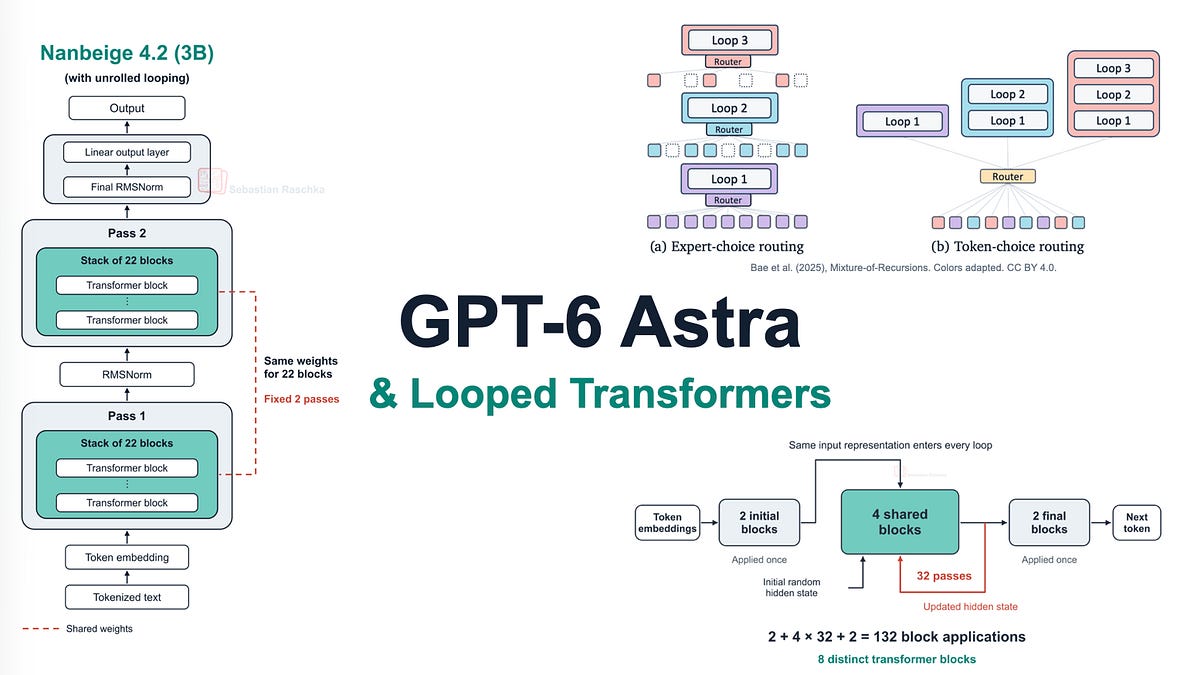
Raschka also flags the less comfortable counterpart: reports of shorter or more opaque reasoning should not be casually explained by rumored architectural changes. His discussion of looped transformers is deliberately technical and restrained: reusing transformer-block weights across passes can reduce stored parameters, but it does not make forward compute or KV-cache requirements disappear. And the claim that Astra uses recurrent depth is not established in the available evidence.
The stronger point is operational rather than architectural. If systems produce less visible reasoning while gaining competence in interactive environments, oversight becomes more dependent on external traces: actions taken, artifacts changed, tests run, and independently checkable outcomes. The article notes a monitorability regression in the system card, but the mechanism and practical magnitude deserve more evidence than current commentary provides.
That should temper both reactions. Do not infer a specific new architecture from a behavior change; do not treat a polished computer-use demo as proof that supervision has been solved. Instead, insist on evaluations that expose the trajectory of work as well as its endpoint.
Workflow Implications
Teams testing new agentic models should evaluate the complete loop. Use representative environments, define success before the run, capture actions and intermediate artifacts, and compare performance across both interactive and conventional tasks. A model that is exceptional with verifiable GUI feedback may be the right tool for one workflow and ordinary in another. The relevant capability claim is always conditional on the harness.
Further Reading
- Sebastian Raschka’s technical review of GPT-6 Astra, looped transformers, and hidden reasoning is worth reading for its separation of observed behavior, reported claims, and architectural speculation.
- Greg Isenberg’s local-AI explainer offers a practitioner-oriented case for a hybrid local-first, cloud-escalation workflow. It is sponsored and should be treated as a workflow prompt rather than an independent product evaluation.