

Agent Fallbacks Need Smaller Model Jobs
Executive Summary
A backup model is not a resilience plan if the application still asks either model to make consequential decisions it cannot reliably justify. The most concrete account in this window is a billing-support experiment in which moving policy, arithmetic, and audit evidence out of the model made two different models pass the same small test suite. The interesting improvement was architectural, not a newly superior model. A separate review of AI disclosure research reinforces the broader point: trust depends on the role AI actually played and what people expected of the human or system behind it, not merely on an AI label.
Both articles were discovered after yesterday’s report cutoff. The billing results are from a vendor-authored, synthetic case study; they are a useful design example, not proof that its selected model or routing service will perform best elsewhere.
What Happened
In AI Tinkerers’ OpenRouter-authored walkthrough, a billing agent initially chose the invoice, applied policy, did calculations, and returned a structured decision. On 20 synthetic cases, Fable 5 produced all expected fields in 14 cases and Grok 4.5 in five. The errors included policy and audit-field mistakes; Fable also had one parsing failure. A provider fallback would keep the service responding, but could still return a wrong decision.
The author then narrowed the model’s job to extracting a three-field intent object. Tested TypeScript handled calculations, policy-version selection, permission checks, and evidence assembly. On the reported suite, both models matched all expected fields in 20/20 cases, including an eight-case frozen holdout. With that narrower contract, the author reports Grok at $0.0555 versus Fable’s $0.1492 across the runs, and median latency of 3.54 versus 5.81 seconds; Grok became primary and Fable fallback. Those numbers are local to this workflow and test set, not a general price-performance ranking.
The causal lesson is more useful than the model ordering. Routing can absorb a provider failure, but separating interpretation from deterministic decisions reduces the range of errors that a replacement model can introduce. It also makes fallback qualification concrete: test each candidate against the same product contract, record which one answered, and add reviewed failures to the evaluation set. Twenty synthetic cases cannot establish production reliability, especially when ambiguous customer language or policy exceptions arrive, but they expose precisely what a useful fallback test should measure.
Why Trust Has a Context
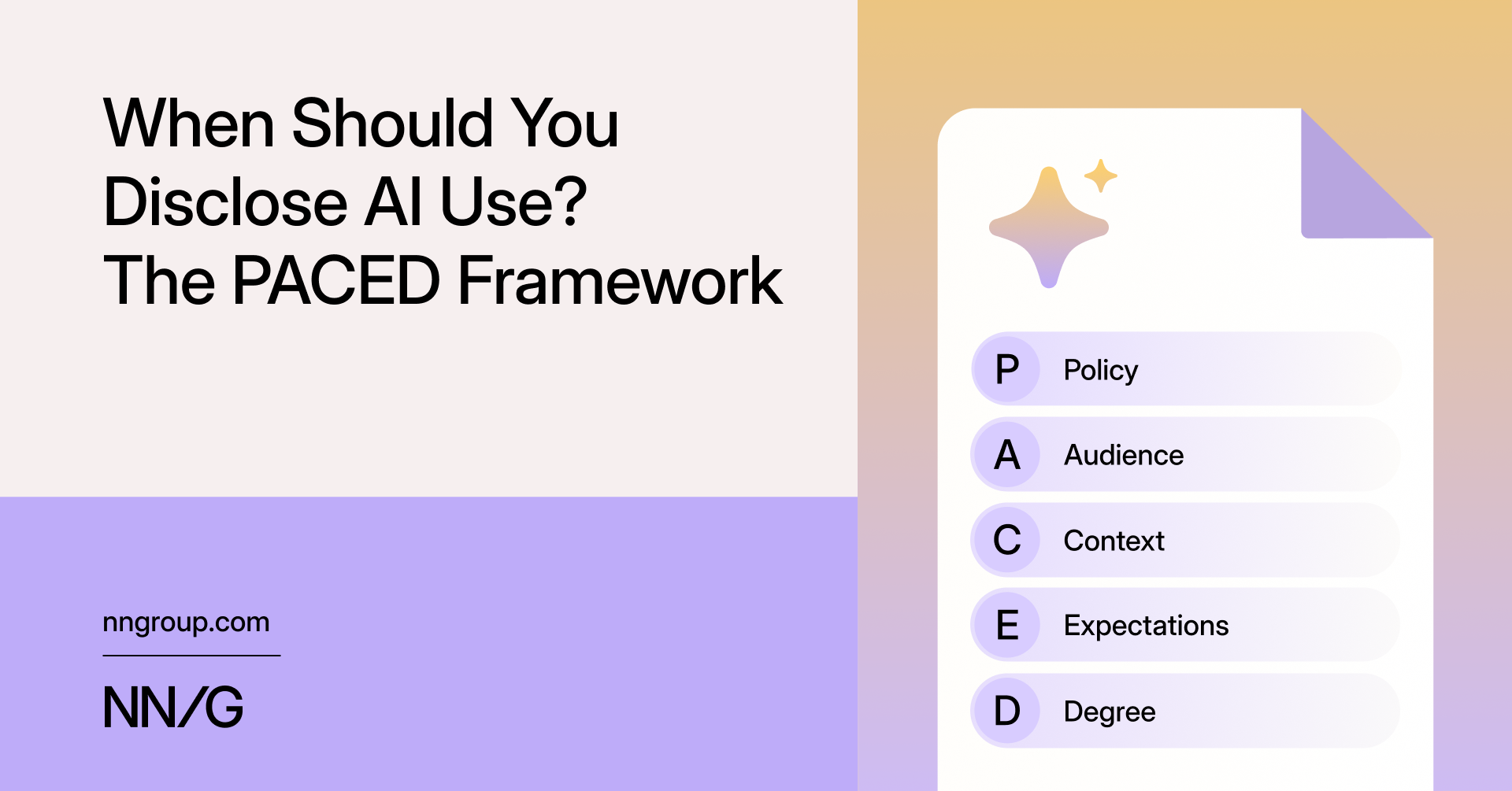
A Nielsen Norman Group review of AI disclosure studies addresses a different side of the same boundary problem: what a user should be told when AI contributes to an output. It finds no universal trust effect from disclosure. Response varies by audience, publisher credibility, content type, and the degree of AI involvement. Disclosed AI use tends to be more costly where readers expect sincerity, creativity, judgment, or human connection; routine transactional contexts can produce smaller penalties. The review also notes a paradox: readers say they want disclosure but may rate disclosed work less favorably, while cited experiments found a larger trust penalty when the AI use was revealed by a third party rather than proactively stated.
Its PACED framework asks teams to consider policy, audience, context, expectations, and degree of contribution. That is not an argument to hide AI use. It is an argument against treating a one-size-fits-all badge as a substitute for accurately describing what AI did. An agent that extracts an intent before code applies a policy is doing something materially different from an agent that invents the final policy decision. The disclosure should reflect that distinction, while the product should enforce it.
The Bigger Story
Yesterday’s discussion of coding and voice agents emphasized measuring model effort against the real task, latency budget, and failure mode. Today’s case pushes that view further: before comparing models, decide which decisions the model is allowed to make at all. Model substitution becomes safer when the boundary is explicit and evaluated. User trust has a parallel requirement: explain AI’s contribution in terms that match its actual authority and the expectations of the setting. Neither a fallback switch nor a disclosure label can compensate for an unclear division of responsibility.