Gemini Robotics 2 Still Faces the Generalization Gap
Executive Summary
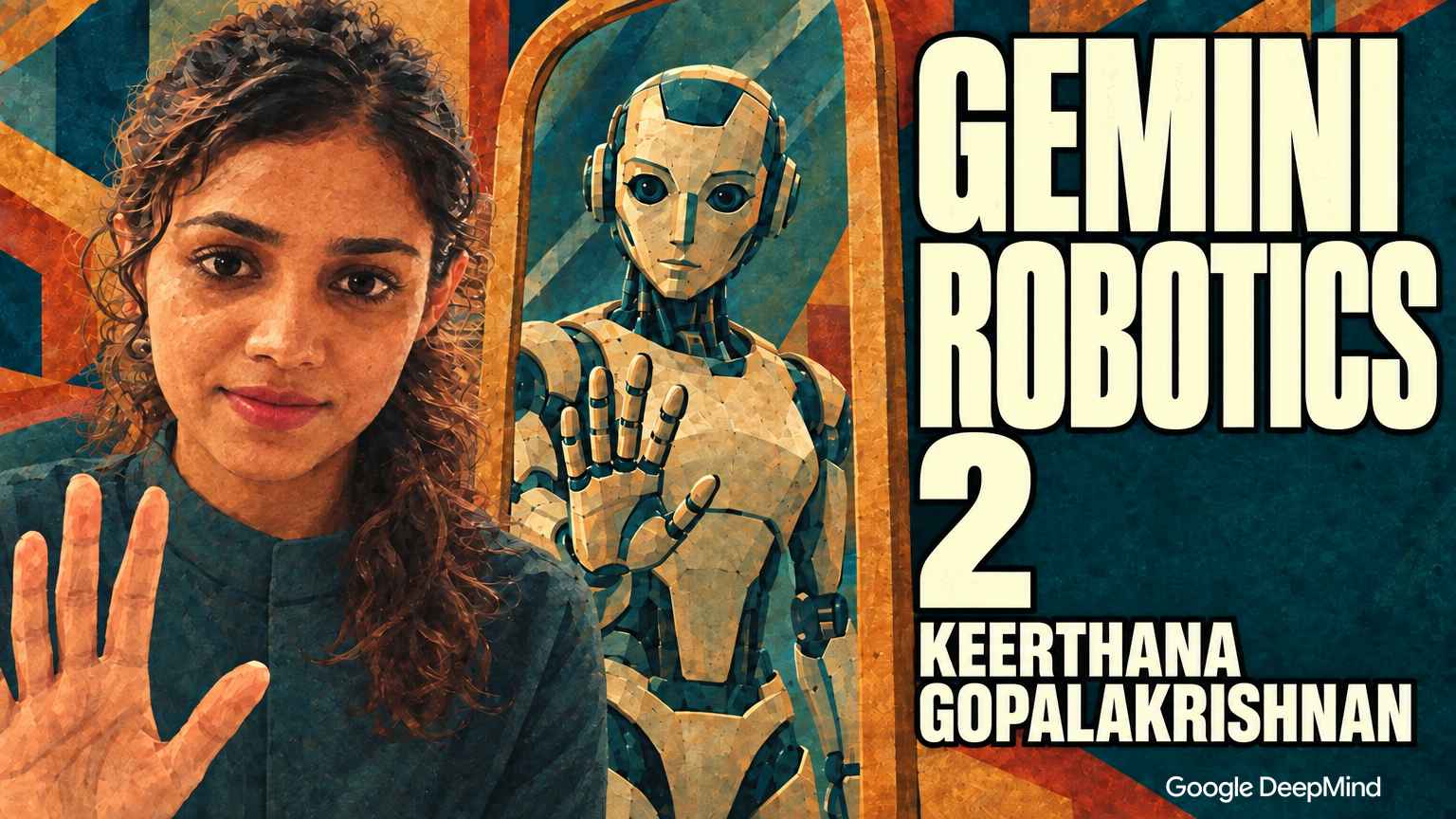
More dexterous humanoids do not yet establish that a general-purpose robot can reliably handle unfamiliar work. In an October 3 interview, Google DeepMind robotics research lead Keerthana Gopalakrishnan separates two kinds of progress: broadening the tasks a model understands and mastering a particular task well enough for deployment. Her assessment remains informally “GPT-2”-like—not because robots cannot follow instructions, but because few-shot learning across difficult tasks and transfer between different robot bodies remain unresolved.
This interview is the substantive item worth centering today. It offers a useful correction to spectacular-demo reasoning: assess changed scenes, unfamiliar hardware and recoverable failures, not just whether a robot completes an impressive demonstration. The technical progress described is the research lead’s account, not an independently reproduced reliability benchmark.
What Happened
Gopalakrishnan describes Gemini Robotics 2 as a layered system: an embodied-reasoning model handles semantic understanding and planning; a vision-language-action model controls movement; and a smaller on-device model supports operation without relying on the cloud. The conversation concerns models released earlier in the summer, rather than a new launch today.
She reports progress in whole-body manipulation and multi-finger dexterity. But her more consequential distinction is between generalization and mastery. A narrow robot can become excellent at one operation without making the next operation much cheaper to learn. A general foundation, she argues, can reduce the work required to specialize across many tasks. That is a research strategy—not a claim that the resulting system already meets production reliability requirements.
The same caution applies to videos showing a robot learning from one demonstration. Copying an observed action is not sufficient evidence of generalization. Her proposed questions are concrete: does the robot still succeed when the scene changes, and does the technique extend beyond familiar pick-and-place tasks to something harder, such as tying a trash bag?
Transfer between bodies adds another hurdle. A language model behaves similarly whether accessed from a Mac or a phone; a robotics policy must contend with different physical capabilities and controls. Success on one robot in one setup cannot establish that the same “brain” is ready for another.
Why It Matters
The interview explains why locomotion clips can mislead expectations about useful household robots. Flat-ground contact is relatively tractable to simulate. Folding cloth introduces friction, deformation and contact dynamics that are harder to model. Progress in sprinting therefore does not straightforwardly predict progress in laundry.
Failure tolerance changes the comparison again. Gopalakrishnan contrasts assembly tasks that permit correction with cracking an egg: a mistake in the latter can leave a mess rather than a recoverable intermediate state. The implication is that task length and completion rate need to be interpreted alongside the consequences of failure. Two superficially similar demonstrations can have very different deployment prospects.
She also resists declaring a single winning data strategy. Teleoperation provides precise robot-specific data but is difficult to scale; sensor-based demonstrations offer another trade-off; human video is abundant but can yield noisy action estimates. Her expectation is a mixture. The broader lesson is to distinguish a promising scaling hypothesis from evidence that it has solved precise physical control.
The Bigger Story
Safety belongs inside capability, in Gopalakrishnan’s framing. A humanoid can injure someone simply by falling, without malicious intent. A robot whose camera becomes obstructed should recognize the problem and ask for help rather than continue blindly. Those are system-level requirements spanning hardware, perception and decision-making—not just better instruction following.
This extends the recent digest view that useful agents need bounded responsibilities and explicit intervention paths. In the physical world, those boundaries must also account for irreversible actions and mechanical instability. Gopalakrishnan argues that people should retain both high-level delegation and lower-level access; an assistant-only interface is insufficient when the robot misunderstands a task or needs correction.
The interview leaves household deployment timelines open. Controlled commercial environments remain easier places to introduce new capabilities than homes with unpredictable layouts and children. The useful update is not a countdown to domestic humanoids. It is a clearer standard for evaluating progress: broader competence matters, but dependable transfer, recovery and human control determine whether that competence becomes useful.
Further Reading
- The Cognitive Revolution: “One Brain, Any Body” — substantial interview with a timestamped transcript; especially useful on generalization versus mastery, cross-embodiment transfer and layered safety.