

Biohub’s Virtual-Cell Bet Starts With Measurement
Executive Summary
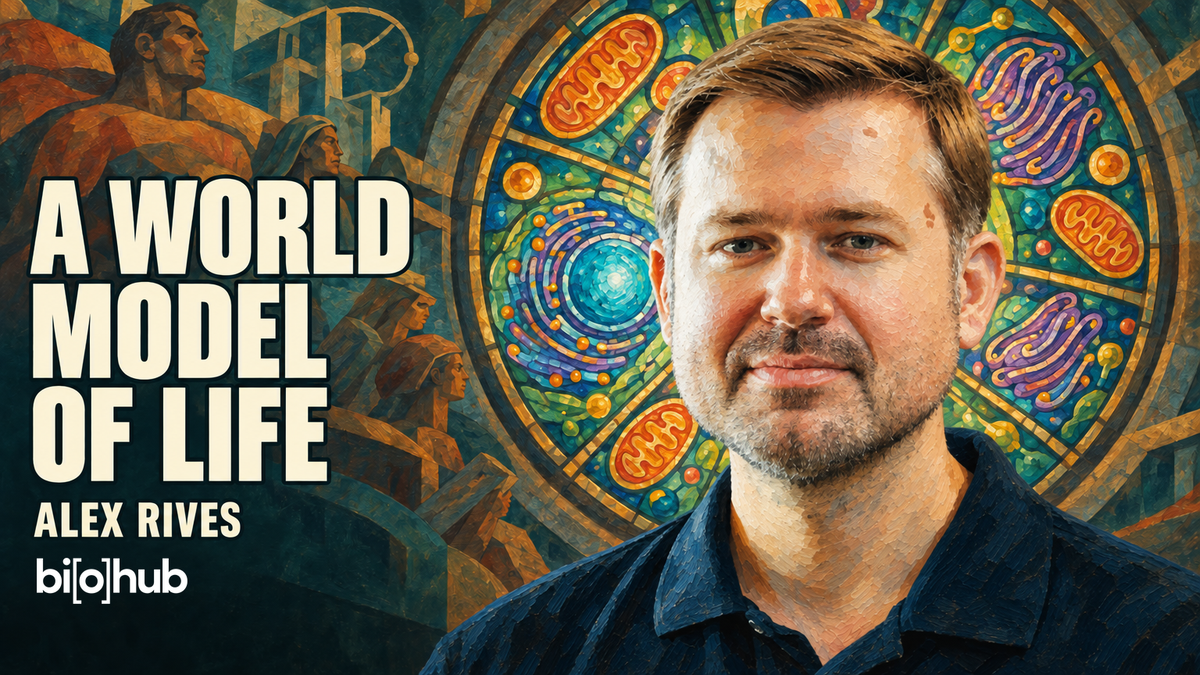
Predictive biology may depend less on a smarter general-purpose model than on measuring things existing datasets cannot reveal. In today’s Cognitive Revolution interview, Biohub Head of Science Alex Rives argues that useful virtual cells require advances in three areas together: modeling, data generation, and observation. His sharpest qualification is that today’s so-called virtual cells do not, in his assessment, meaningfully simulate a cell well enough to serve as an experimental oracle.
The consequential idea is a research strategy, not a demonstrated breakthrough: build the measurements and experimental feedback that make better predictions possible. Rives’s ambitions remain forecasts; the interview does not establish that a general predictive cell model already works.
What Happened
Rives separates a distant “world model of life” from a nearer-term target: a model that takes a cell’s state and an intervention, then predicts a distribution of subsequent states. That distinction matters. A probabilistic account of cellular responses is a more bounded objective than simulating every molecular interaction, while still potentially helping researchers identify interventions worth testing.
He thinks an information-level model of this kind could become attainable over roughly five years. But he also says the fully multiscale model—connecting molecular detail, cellular programs, tissue interactions, and development—is far away. Neither timeline should be mistaken for an independently validated capability forecast.
The financial backdrop is substantial but older. Background, not a new announcement: Biohub’s October 7 expansion announcement describes a $1.8 billion coordinated commitment spanning funding, data, computation, and measurement technology. It is not all newly committed cash: NIH’s contribution includes resources developed through more than $500 million in prior federal investment. Today’s contribution is the interview’s explanation of what that effort is trying to unlock.
Why Measurement Comes First
Rives’s argument is more specific than “biology needs more data.” Cells have to be understood in context: their neighbors, tissue environment, molecular state, and responses over time. More observations of an inadequate proxy may still leave the important relationships invisible.
He points to several complementary approaches: higher-contrast electron microscopy for examining macromolecules, imaging cells within tissue, and tracking development in transparent zebrafish. These operate at different scales; none alone supplies a complete picture. The challenge is both collecting richer observations and learning how to connect them.
Architecture still matters in this account. Rives argues that cellular biology is sufficiently data-constrained that useful structural assumptions remain important; he questions whether the standard transformer supplies the right multiscale organization. That is his research judgment, not evidence that transformers cannot contribute to biological modeling.
The initiative’s less glamorous commitments are therefore central: shared standards, common identifiers, and unified access. Measurements from different institutions cannot automatically become a coherent training resource merely because they are numerous or publicly available.
The Bigger Story
The interview sharpens a recurring distinction in AI progress: generating a plausible hypothesis is not the same as verifying it. Rives envisions systems that propose experiments, perform them, learn from the results, and propose better experiments. Unlike checking a program or a mathematical answer computationally, the relevant feedback here must ultimately come from the laboratory.
His caution about language is equally important. The biological facts researchers most want to discover are not necessarily recorded in text or derivable from existing knowledge. Better reasoning over scientific literature can help, but cannot substitute for observations that have never been made.
This extends the familiar case for better data access and verification, while making its limits more concrete. In biology, the missing information may require a new instrument or experiment, not another software integration. The meaningful test of the virtual-cell bet will be whether models predict responses that hold up experimentally—not whether they produce convincing biological explanations.
Further Reading
- Alex Rives on virtual cells and measurement — the substantial interview, especially the distinction between near-term cell-state prediction and a distant world model.