
Datasette Adds Local-Model Support
Executive Summary
- Datasette’s database agent can now use local models through OpenAI-compatible endpoints. Simon Willison’s plugin update connects it to LM Studio, Ollama and llama.cpp, giving builders another way to run an agent over their own databases.
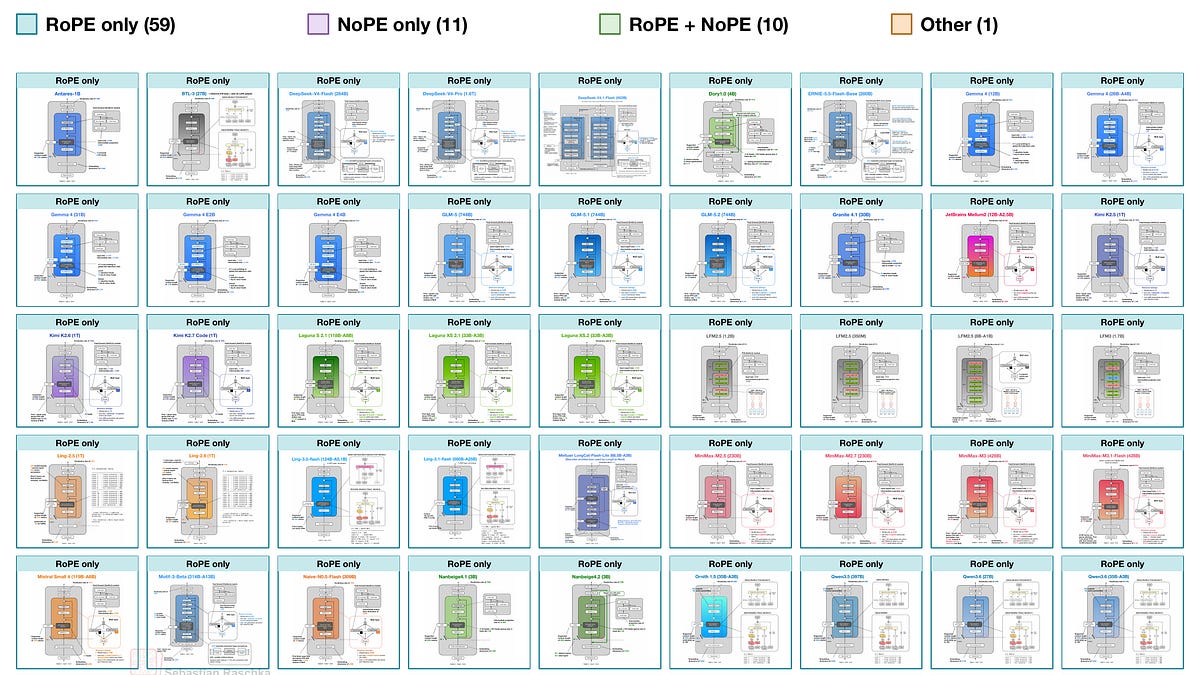
- Sebastian Raschka maps the changing use of positional encodings in open models. His architecture catalog shows more models rotating only some attention features or omitting rotation in selected layers—two different choices worth distinguishing when inspecting model configurations.
Datasette’s Agent Can Use a Local Endpoint
Willison’s November 14 datasette-llm 0.1a11 release adds support for arbitrary OpenAI-compatible endpoints. The plugin supplies shared model configuration for other Datasette plugins, so the change also enables Datasette Agent to use a locally served model.
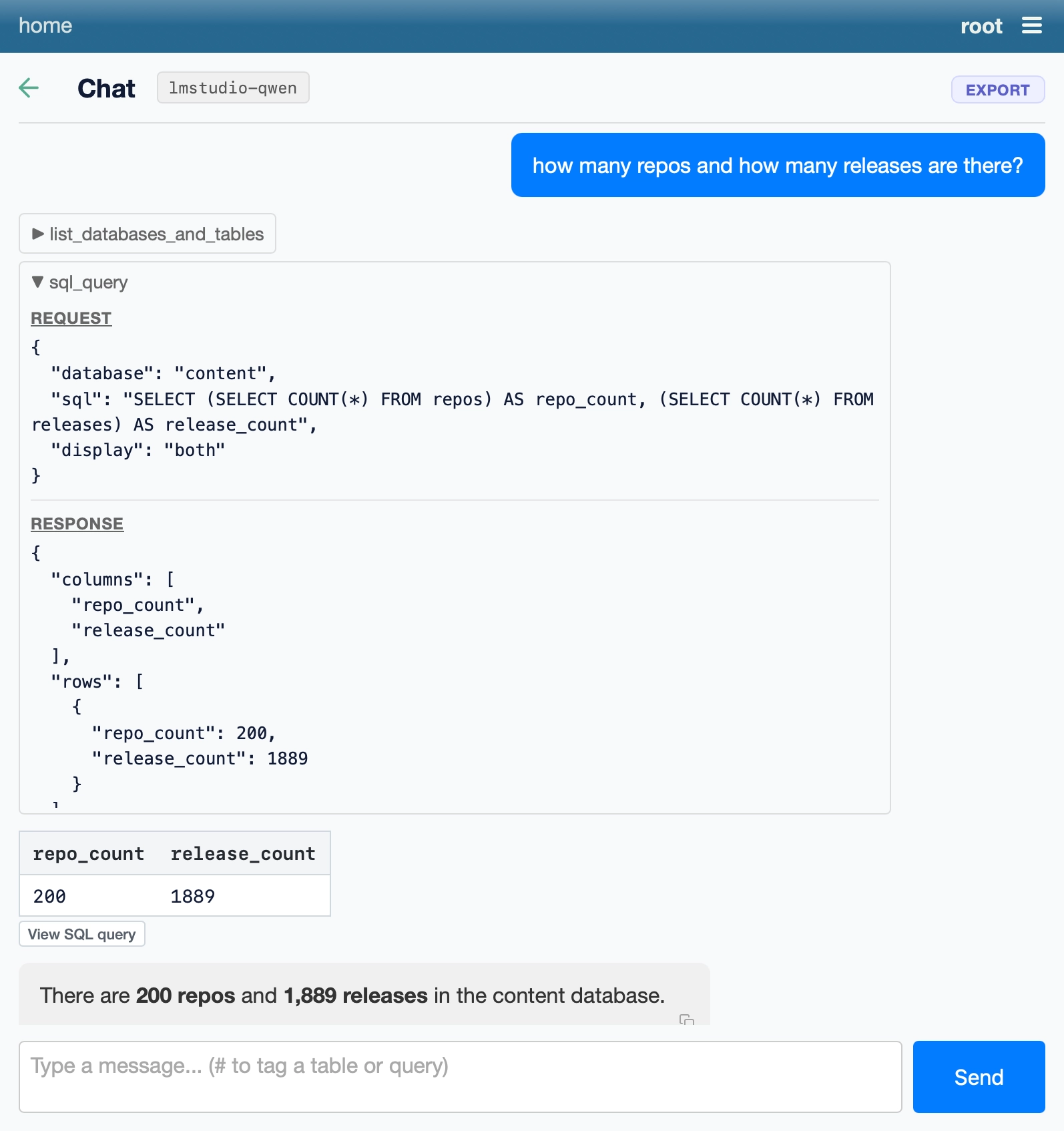
His example points at LM Studio’s http://localhost:1234/v1 endpoint, selects qwen/qwen3.8-27b, and launches Datasette with its agent plugin through uvx. The accompanying demonstration shows the agent inspecting database tables and running SQL to answer a question. The same endpoint configuration can target compatible hosted services.
For developers already running a local model server, this removes an integration step between the model and a database-backed agent interface. It also makes it easier to compare local and hosted models inside the same application. Check tool calling and generated SQL against your actual schema before relying on the answers.
Raschka Separates Two Ways to Use Less RoPE
Raschka’s November 15 positional-embeddings walkthrough combines visual explanations, math and PyTorch code with a comparison of recent architectures.
Rotary position embeddings, or RoPE, encode position by rotating query and key vectors inside attention. Partial RoPE rotates only a subset of their features. Mixed RoPE/NoPE architectures instead omit explicit positional encoding in some attention layers. A model can make both choices.
One concrete example is the 3-billion-parameter SmolLM3: every fourth block in its 36-block architecture skips RoPE. Its authors reported better long-context performance with that pattern. Those blocks still receive representations from earlier layers, including positional information introduced upstream.
In Raschka’s catalog, partial RoPE goes from a minority of RoPE-using entries in 2025 to a majority in both 2026 groups. Applying RoPE in every softmax-attention layer remains the most common arrangement, though its share falls. The groups are small and model variants count separately, so these are descriptive catalog results. Section 6 is the useful starting point for readers who already understand the mechanics and want to compare architecture choices.